

A welded mesh panel may look simple at first glance, but its buying schedule combines material, wire, opening, panel size, edge condition, finish and quantity. Before packing begins, those values need to point to the same approved requirement. A structured checkpoint prevents a correct-looking panel from being released against the wrong revision or bundled under an incomplete item description.
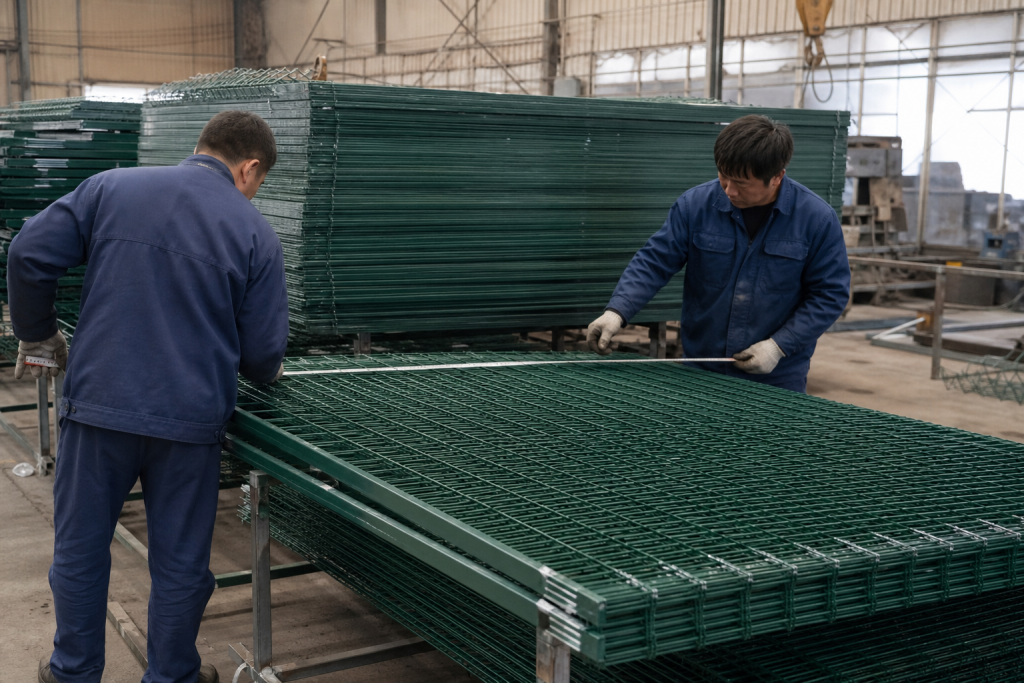

This factory note explains the decisions and records that help a buyer connect an approved requirement with production, inspection and dispatch. It describes a practical sourcing route rather than a claim about a particular order, customer or test programme.
What the approved panel schedule controls
The approved schedule should identify the panel as a complete manufactured item, not only as a mesh opening. It connects nominal wire and aperture information with finished dimensions, edge treatment, frame or bend details, finish and package quantity.
A useful review asks which drawing revision controls production, whether dimensions are nominal or finished, and how each item code maps to the order. Recording those points in the same schedule reduces assumptions between the product description, the drawing, the quotation and the packing list. It also makes later revisions easier to identify because the reason for each selection remains visible.
Use one consistent item reference across drawing, inspection note and packing list so the receiving team can trace the supplied panel. For procurement, the important boundary is to separate a nominal product description from the values that are actually approved for manufacture. Where site conditions, standards or calculations govern the result, the responsible designer or buyer should confirm them before production release.
Dimensional and visual checkpoints
Panel width, height, squareness, wire spacing and visible weld condition are reviewed against the approved basis. The inspection method should suit the product construction and avoid implying a tolerance or acceptance rule that was never agreed.
A useful review asks where dimensions are measured, which sample frequency is expected, and how edge wires and welded intersections are assessed. Recording those points in the same schedule reduces assumptions between the product description, the drawing, the quotation and the packing list. It also makes later revisions easier to identify because the reason for each selection remains visible.
Record the measurement basis as well as the result; a number without its location or method can create a false comparison. For procurement, the important boundary is to separate a nominal product description from the values that are actually approved for manufacture. Where site conditions, standards or calculations govern the result, the responsible designer or buyer should confirm them before production release.
Protecting the finish before packing
Surface condition can be affected by stacking, banding, contact between dissimilar parts and movement during handling. The packing route therefore needs to consider the actual finish, panel geometry and expected lifting sequence.
A useful review asks whether the finish is galvanized or coated, where separators are needed, and which faces or corners need extra protection. Recording those points in the same schedule reduces assumptions between the product description, the drawing, the quotation and the packing list. It also makes later revisions easier to identify because the reason for each selection remains visible.
Choose protection that limits avoidable contact damage without trapping moisture or making safe unloading difficult. For procurement, the important boundary is to separate a nominal product description from the values that are actually approved for manufacture. Where site conditions, standards or calculations govern the result, the responsible designer or buyer should confirm them before production release.
Records buyers should align
A useful release record brings the item count, panel identification, inspection reference and package number together. Photographs may support the record, but they do not replace the agreed dimensional and commercial documents.
A useful review asks which report travels with the order, how package numbers appear on the packing list, and who approves a deviation or revision. Recording those points in the same schedule reduces assumptions between the product description, the drawing, the quotation and the packing list. It also makes later revisions easier to identify because the reason for each selection remains visible.
Confirm the document set before dispatch so a missing report is not discovered only after the goods reach the destination. For procurement, the important boundary is to separate a nominal product description from the values that are actually approved for manufacture. Where site conditions, standards or calculations govern the result, the responsible designer or buyer should confirm them before production release.
Pre-packing checklist
Before welded mesh panels move to the packing area, confirm the following information against the current order. A concise schedule is more useful than a long message with missing values, so mark unknown items clearly and attach the drawing, bill of quantities or reference image that controls the discussion.
- Approved item code and drawing revision
- Finished panel dimensions and quantity
- Wire, opening and edge construction
- Surface finish and visible condition
- Package grouping and separator requirement
- Packing-list and inspection-record references
The result should be a traceable package in which the physical panels, labels and supporting documents describe the same item. When one of these values is not fixed, state the decision owner and the date by which it is needed. That keeps an open technical question from becoming an unrecorded production assumption.
Continue the sourcing review
This article describes a general control route and does not state a universal sampling plan, tolerance or test standard. Use the related BOHANG routes below to compare the relevant product family, application context and supply capability before sending the final inquiry.
- Review BOHANG quality-control capabilities
- Review packaging and loading capabilities
- Send a project or product brief
For a quotation, provide the intended use, dimensions or product schedule, quantity, finish, destination and required delivery timing. BOHANG can then review the available manufacturing and supply route against the information provided.

